










A useful connection can introduce you to someone. A strong network can change what you have access to.
For Abimbola Akinnuoye, founder of Leading Ladies Connect, that distinction has become the foundation of her work with women entrepreneurs and professionals in Canada. Through mentorship, business events, funding opportunities, strategic partnerships and storytelling, Leading Ladies Connect has developed a network built around helping women move from meeting people to accessing resources they can use. In 2025, Akinnuoye reported that the organization supported women with more than $75,000 in funding, hosted over 20 events and staged its first $25,000 pitch competition. In 2026, the platform returned with another funding competition and held its third annual Leading Ladies Conference on May 2 at Microsoft Canada in downtown Toronto.
The timing matters. Women now own a growing share of Canadian businesses, but access to capital, networks and growth resources remains uneven. Statistics Canada reported that majority women-owned businesses accounted for 20.9% of Canada’s private-sector businesses in the third quarter of 2025, while federal entrepreneurship policy continues to identify financing as a persistent obstacle for women founders.
Akinnuoye’s response is straightforward: make connection useful.
Who Is Abimbola Akinnuoye?
Abimbola Akinnuoye is the founder of Leading Ladies Connect, a Canadian community for women entrepreneurs and professionals focused on mentorship, business growth, strategic relationships, funding access and professional development. She is also founder of The Canada Plug, host of Leading Lady Talks and a national volunteer leader with Lean In Canada.
Her professional experience spans more than two decades across business development, strategic partnerships, marketing, entertainment and event production, according to her Leading Ladies Connect profile. That background helps explain why her model of community-building is less about gathering people in a room and more about what happens once they are there.
Akinnuoye’s public work consistently sits at the intersection of people and opportunity: identify a need, assemble the right relationships around it, and create a pathway through which information, mentorship, visibility or capital can move.
Microsoft has also featured Akinnuoye in programming at Microsoft Reactor Toronto, identifying her as founder and CEO of Leading Ladies Connect and The Canada Plug. Microsoft Reactor’s speaker profile provides an external corporate reference for that work.
Why Networks Matter for Women Entrepreneurs in Canada
Entrepreneurship is often presented as a test of individual ambition.
The data tells a more complicated story.
Women are building a larger share of Canada’s businesses. Statistics Canada reported that majority women-owned businesses represented 19.5% of private-sector businesses in the first quarter of 2025, up from 17.6% a year earlier. By the third quarter of 2025, that share had reached 20.9% — roughly one in five private-sector businesses.
Growth in ownership, however, does not eliminate structural constraints.
Canada’s Women Entrepreneurship Strategy continues to address barriers including financing, networks and access to the business supports women need to start and scale companies. In June 2026, the federal government announced plans for a new Support for Women Entrepreneurs Program as part of that wider strategy.
The federal government’s own assessment of the Women Entrepreneurship Strategy has also acknowledged gaps in access to capital, noting that women entrepreneurs are often concentrated in younger, smaller and historically underfinanced businesses and sectors.
That context is important when evaluating organizations such as Leading Ladies Connect.
Networking by itself does not solve financing inequality.
But a useful network can connect a founder to information, an experienced mentor, an investor, a funding program, a potential customer or someone who already understands the problem she is trying to solve.
That is where connection starts to acquire economic value.
How Leading Ladies Connect Turns Networking Into Business Infrastructure
Leading Ladies Connect describes itself as a community for women entrepreneurs and professionals.
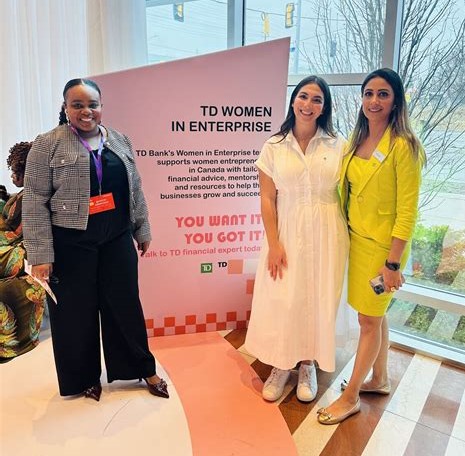
Its activities extend across several formats: networking gatherings, conferences, workshops, mentorship, funding information, business opportunities, storytelling and professional resources. The organization also says it has collaborated with companies including Microsoft, BDC, TD Bank and L’Occitane.
These partnerships matter when they produce access rather than simply logos on an event poster.
Akinnuoye has increasingly structured LLC programming around practical areas such as entrepreneurship, capital, technology, visibility and professional development.
The result is a model in which community becomes the entry point, rather than the final product.
What is the MentorHER program?
One of the clearest examples is MentorHER, Leading Ladies Connect’s one-to-one mentorship initiative.
The MentorHER program connects participants with experienced professionals and entrepreneurs for individualized guidance. LLC describes its focus areas as personalized advice, industry insight and targeted support for entrepreneurship or professional development.
Its published mentor roster spans business, finance, technology, education, branding, health, design and entrepreneurship.
That variety is important.
A founder trying to secure financing has different needs from a woman navigating a corporate transition. Someone building a brand may need marketing expertise; another participant may need help developing systems or understanding a new industry.
Effective mentorship becomes more useful when the expertise matches the problem.
From Conversation to Capital: Measuring Leading Ladies Connect’s Growth
Community organizations frequently speak about “impact.” Numbers make that claim easier to examine.
Akinnuoye’s year-end 2025 account of Leading Ladies Connect provides several measurable indicators of the organization’s activity.
| Publicly reported LLC milestone | Figure |
|---|---|
| Funding support reported for women in 2025 | More than $75,000 |
| First LLC pitch competition | $25,000 |
| Events hosted in 2025 | 20+ |
| Leading Lady Talks episodes released | 11 |
| Applications reported for the previous pitch competition | 614 |
| Countries represented among applications | 13 |
| 2026 pitch competition offer | Up to $15,000 |
The first four figures come from Akinnuoye’s own public 2025 year-end report and should therefore be understood as organization-reported figures rather than independently audited statistics.
For the 2026 competition, Akinnuoye said the previous round had attracted 614 applications from 13 countries. The 2026 edition offered women-led businesses up to $15,000 in funding plus mentorship, with applications closing April 1.
That progression illustrates an important aspect of LLC’s development.
The organization is not abandoning networking. It is attempting to connect networking with outcomes that founders can measure: capital, mentorship, visibility and market access.
Leading Ladies Conference 2026 Put AI, Funding and Business Growth Together
By 2026, that philosophy was increasingly visible in Leading Ladies Connect’s flagship conference.
The third annual Leading Ladies Conference took place on Saturday, May 2, 2026, at Microsoft Canada, 81 Bay Street in downtown Toronto. The theme was “Built to Scale: AI, Capital & Women Shaping the Future.”
The programme brought together women founders, professionals, funders and ecosystem leaders around topics including practical artificial intelligence, funding readiness, business growth and strategic networking.
The conference’s positioning was unusually direct:
“This is not just about inspiration. It’s about clarity, confidence, and access.”
That line from the Leading Ladies Conference 2026 programme captures an important distinction in women’s entrepreneurship programming. Inspiration can motivate someone to begin. It cannot, by itself, finance a business, develop a business model or introduce a founder to the right market.
The 2026 conference therefore included AI-focused workshops, funding discussions, a live pitch competition, a curated marketplace and structured networking.
Its venue also reflected LLC’s growing relationship with Microsoft. In January 2025, Leading Ladies Connect had already partnered with Microsoft Reactor Toronto for programming focused on women and emerging AI trends.
Rather than treating technology as separate from women’s economic advancement, the 2026 conference placed AI beside funding and business development, three issues increasingly shaping whether small businesses can compete and scale.
Access to Capital Is Still One of the Hardest Problems
The emphasis on funding is not accidental.
Canada has spent years building programmes specifically around the barriers facing women entrepreneurs.
The federal Women Entrepreneurship Loan Fund provides loans of up to $50,000, with particular attention to start-ups, underrepresented groups and sole proprietorships.
The wider Women Entrepreneurship Strategy also includes ecosystem and venture-capital initiatives intended to improve the environment in which women-owned businesses seek financing and grow.
These public programmes demonstrate a larger point: Canada does not lack talented women who want to build businesses. Policymakers themselves recognize that the conditions surrounding those businesses — access to capital, networks, knowledge and appropriate support, influence what happens next.
Leading Ladies Connect operates within that broader ecosystem, but from the community side.
Government programmes can create funding mechanisms. Financial institutions can provide products. Corporations can open doors.
Organizations such as LLC can help women know those doors exist, understand what is expected when they reach them and meet people who have already navigated similar decisions.
Abimbola Akinnuoye’s Leadership Extends Beyond Leading Ladies Connect
Akinnuoye’s community-building work is not confined to LLC.
She also founded The Canada Plug and hosts Leading Lady Talks, which highlights women and their experiences through interviews and storytelling. Leading Ladies Connect reported releasing 11 episodes of the show during 2025.
Her national leadership role with Lean In Canada adds another layer.
Leading Ladies Connect’s own biography previously described her as Director of Engagement, but Lean In Canada’s current leadership directory now identifies Akinnuoye as Director of Membership & Community (Volunteers & External). Lean In Canada’s current leadership team should be treated as the authoritative source for her present title.
Lean In Canada operates networks and Circles across the country, including Toronto, Vancouver, Calgary, Edmonton and Ottawa, as well as community groups connected to Halifax and Montreal.
That role places Akinnuoye’s work inside a broader national conversation about women’s careers, leadership and professional community.
Why Abimbola Akinnuoye’s Model Matters for Women in Business
One of the strongest ideas behind Akinnuoye’s work is also one of the simplest: opportunity rarely travels alone.
A funding opportunity needs information.
Information needs visibility.
A founder may need confidence to apply, but she may also need someone who understands the application.
A professional trying to change industries may need skills, but she may also need a credible introduction.
An entrepreneur trying to grow can need capital and still fail without customers, partnerships or market knowledge.
This is where “networking” becomes a misleadingly small word for what strong business communities can actually do.
Afro Diaspora Pulse has documented similar themes in its coverage of Black entrepreneurs accessing funding opportunities in Canada and career growth through connection and knowledge. In both cases, the underlying issue is not simply ambition. It is access.
The same applies to women’s financial confidence. Knowledge can affect whether someone sees investment, entrepreneurship or ownership as an option available to them, a theme explored in Afro Diaspora Pulse’s feature on helping women invest without fear.
Akinnuoye’s work brings those strands together around community.
What Comes Next for Leading Ladies Connect?
The next test for Leading Ladies Connect is scale.
Its public milestones show expansion: more events, corporate collaborations, mentorship infrastructure, a pitch competition with international applicants and a flagship conference moving deeper into conversations around capital and technology.
But meaningful scale should ultimately be measured beyond attendance.
Useful questions include:
- How many mentored women achieve measurable career or business milestones?
- How much capital ultimately reaches founders through LLC programmes and connections?
- How many businesses survive and grow after participating?
- How many partnerships translate into customers, contracts, financing or employment?
- How accessible are these opportunities to women who are not already connected to established professional networks?
Those are demanding measures, but they are also the measures that distinguish community activity from an enduring economic ecosystem.
Leading Ladies Connect already has something valuable to build from: people are showing up.
The opportunity now is to keep converting that participation into measurable access.
Connection Is Most Powerful When It Leads Somewhere
Abimbola Akinnuoye’s work offers a useful counterpoint to the idea that networking is simply collecting contacts.
Through Leading Ladies Connect, her model connects community with mentorship, education, capital, visibility and partnerships. Its programmes range from one-to-one MentorHER relationships to conferences and funding competitions, while her work with Lean In Canada extends that commitment into a national women’s leadership network.
Canada’s women entrepreneurs are building more businesses and occupying more economic space. The question is whether the systems surrounding them will expand at the same pace.
For Akinnuoye, connection is one part of that infrastructure. Its real value is not measured by how many people are in the room. It is measured by what becomes possible because they met there.




Maryam Murtala’s Legacy: How Canada Vendors Became a Voice for Nigerian Entrepreneurs - Afro Diaspora Pulse
Feb 5, 2026[…] Across Canada’s diaspora ecosystem, other women leaders have similarly built platforms focused on mentorship, entrepreneurship and access to o… […]