



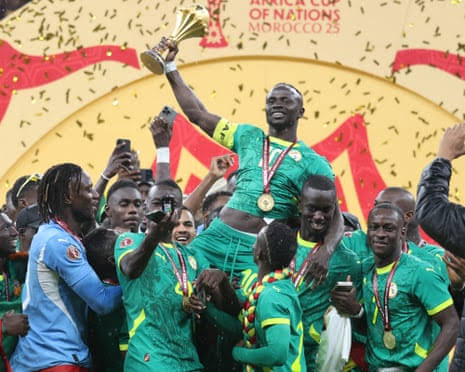



In January 2026, the 2025 Africa Cup of Nations (AFCON) concluded in chaos when a controversial late penalty led Senegal to temporarily walk off the pitch before returning to defeat host nation Morocco 1–0 in extra time.
Two months later, the Confederation of African Football (CAF) stunned the sporting world by stripping Senegal of the trophy for that brief walkout and awarding the title to Morocco, a ruling that the Court of Arbitration for Sport (CAS) officially overturned on November 24, 2026, restoring Senegal as the rightful champions.
The Tournament Background and the Rabat Final
The 35th edition of the Africa Cup of Nations took place in Morocco across December 2025 and January 2026, carrying immense expectations for the host nation. Having reached the semi-finals of the 2022 FIFA World Cup, the Atlas Lions were heavily favored to end a 50-year continental title drought on home soil.
Standing in their way in the January 18, 2026 final at the Prince Moulay Abdellah Stadium in Rabat was Senegal, a modern African powerhouse seeking its second continental crown after first lifting the trophy in 2021.
For 90 minutes, the two heavyweights neutralized each other in a fiercely physical, tactical stalemate. The defining flashpoint arrived in the seventh minute of second-half stoppage time. Following a Video Assistant Referee (VAR) review for a challenge inside the penalty area, Congolese referee Jean-Jacques Ndala awarded Morocco a penalty kick.
Believing the decision was unjust and influenced by the partisan atmosphere, Senegal head coach Pape Thiaw instructed his players to leave the pitch in protest. Play was halted for roughly 15 minutes while security officials struggled to contain disorder along the touchlines and in the stands.
Crucially, referee Ndala did not blow the final whistle to abandon the match. Following tense negotiations, Senegal returned to the field, Moroccan forward Brahim Díaz missed the decisive spot-kick, and Senegal midfielder Pape Gueye scored a dramatic 94th-minute winner in extra time to clinch the 1–0 victory.

The CAF Appeals Board Reversal
While Senegal celebrated their victory at home, the Royal Moroccan Football Federation (FRMF) filed a formal protest with CAF, arguing that Senegal’s unauthorized departure from the pitch constituted a forfeit under tournament regulations.
Initially, CAF’s Disciplinary Board rejected the push to overturn the result, choosing instead to punish Senegal with heavy financial fines and touchline bans for its coaching staff.
However, Morocco appealed the ruling, and on March 17, 2026, the CAF Appeals Board delivered an unprecedented verdict. Citing Articles 82 and 84 of the AFCON regulations, which mandate that any team leaving the pitch without the referee’s permission loses the match by forfeit, the board voided Senegal’s extra-time win, stripped the Teranga Lions of their medals and trophy, and declared Morocco 3–0 winners.
The decision plunged African football into crisis, sparking accusations of institutional bias and creating an unprecedented situation where both nations traveled to the 2026 FIFA World Cup claiming to be the reigning champions of Africa.
The CAS Verdict and Legal Reasoning
The Senegalese Football Federation (FSF) immediately challenged the administrative stripping of their title at the Court of Arbitration for Sport in Lausanne, Switzerland. After months of written submissions and an October hearing, a three-member CAS panel issued a unanimous ruling on November 24, 2026, annulling the CAF Appeals Board’s decision and reinstating Senegal’s 1–0 triumph.
The tribunal grounded its verdict in two foundational principles of international sports law:
- The “Field of Play” Doctrine. CAS reaffirmed that sports governing bodies and appeals boards cannot retroactively overturn the on-field discretionary judgments of match officials once a game has been completed.
- Referee Authority under IFAB Law 5. The panel emphasized that referee Jean-Jacques Ndala held the sole authority to abandon the match during Senegal’s walkout. Because he exercised his discretion to pause the match, allow the players to return, and play the fixture to its natural conclusion, CAF could not invoke forfeiture rules after the fact.
Broader Impact on African Football
The reinstatement of Senegal’s title carries lasting consequences for the governance and reputation of African football. For Senegal, the ruling brought complete vindication after eight months of sporting limbo, allowing the nation to officially reclaim its second AFCON star.
For CAF, however, the saga represents a severe institutional embarrassment. By allowing an internal appeals panel to strip a champion on a technicality, only to have that decision dismantled by an international court, CAF faced widespread criticism over its legal competence and governance standards.
While the FRMF has expressed deep frustration and indicated it may review options at the Swiss Federal Court, the CAS ruling effectively closes the chapter on one of the most turbulent sagas in international football history, ensuring that the 2025 AFCON title remains with the team that won it on the pitch.