
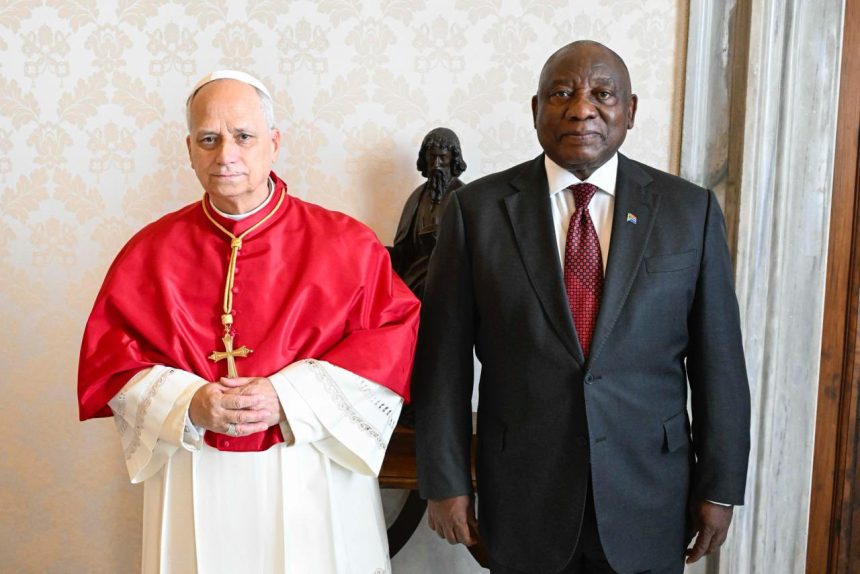
South African President Cyril Ramaphosa met with Pope Leo XIV at the Vatican’s Apostolic Palace on Saturday in a gesture that underscored Africa’s growing diplomatic footprint and moral voice in global affairs.
The cordial meeting — featuring an exchange of gifts and discussions on peace, development, and inter-faith cooperation — was described by Pretoria as an effort to “foster mutual understanding and strengthen cultural ties.”
For Africa, the moment reflected not only South Africa’s leadership within the continent but also the Vatican’s acknowledgment of Africa’s pivotal role in shaping conversations around justice, migration, and climate action.
“President Ramaphosa conveyed appreciation for the Catholic Church’s role in community building and reconciliation in South Africa,” an official statement noted.
Diplomatic Warmth Amid Global Tensions
The Vatican audience took place against the backdrop of escalating diplomatic tension following the United States’ decision to boycott the upcoming G20 Summit in Johannesburg, the first to be held on African soil.
Just a day earlier, U.S. President Donald Trump announced that no American delegation — including Vice President J.D. Vance — would attend, citing alleged “abuses” against white Afrikaner farmers.
The boycott drew swift criticism from African and international observers, who viewed the statement as inflammatory and dismissive of South Africa’s post-apartheid progress.
Washington’s Claims and Pretoria’s Response
In a message posted on his social platform, Trump called South Africa’s G20 hosting “a complete disgrace,” claiming his administration would instead prioritise refugee spaces for “white South Africans facing persecution.”
Pretoria rebuffed the allegations as “completely false.” President Ramaphosa confirmed he had personally told Trump that the claims were unfounded and distorted South Africa’s social realities.
“White South Africans continue to enjoy the country’s highest living standards,” said a senior official, highlighting the irony of Washington’s narrative.
Analysts note that while racial disparities persist, the U.S. rhetoric misrepresents South Africa’s democratic gains and complex social structure, casting Africa yet again through outdated lenses.
Faith and Global Solidarity
For Ramaphosa, the meeting with Pope Leo XIV offered a counter-narrative — one grounded in bridge-building, not division. The conversation reportedly touched on Africa’s leadership in peacekeeping, humanitarian outreach, and the shared moral responsibility of faith communities in addressing inequality.
The encounter symbolised Africa’s assertion of soft power — engaging the Vatican, the West, and global partners on equal terms.
A Defining Moment for African Global Relations
As South Africa prepares to host the historic G20 Summit later this month, the Vatican visit reinforces Ramaphosa’s diplomatic message: that Africa is not a backdrop to global politics, but an active participant shaping its direction.
The image of a South African president standing beside the leader of the Catholic world amid geopolitical controversy sends a clear statement — Africa’s voice will not be sidelined.