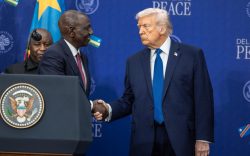

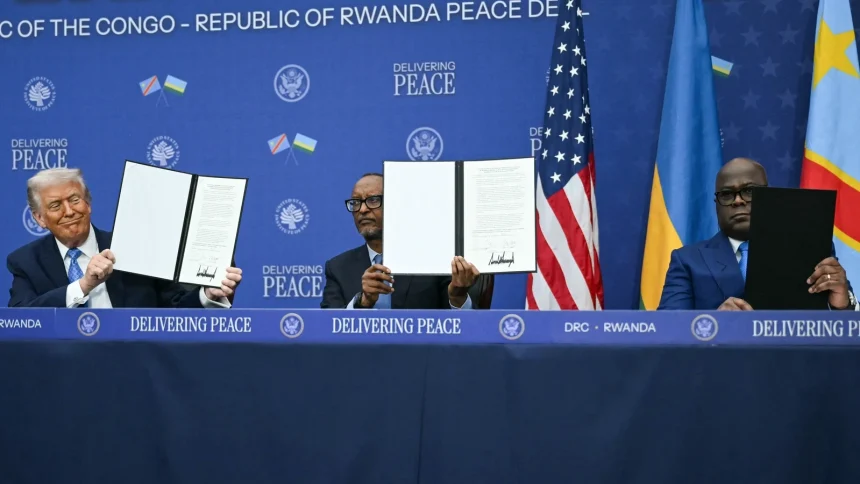
The Democratic Republic of the Congo (DRC) and Rwanda have signed the Washington Accords for Peace and Prosperity, a sweeping agreement aimed at ending decades of conflict and unlocking transformative economic opportunities across the Great Lakes region. The ceremony, hosted on December 4 by U.S. President Donald J. Trump in Washington, marks one of the most ambitious diplomatic efforts involving Central African nations in recent years.
President Felix Tshisekedi signed on behalf of the DRC, while President Paul Kagame represented Rwanda. The high-level event drew a robust African and international delegation, including leaders and envoys from Togo, Angola, Burundi, Kenya, Uganda, Qatar, the UAE, and the African Union—a reflection of the agreement’s continental significance.
What the Washington Accords Mean for the Region
The Accords reaffirm both countries’ pledge to fully implement the June 27, 2025 Peace Agreement, strengthening commitments to demilitarization, cross-border security cooperation, and long-term stability.
A central pillar of the signing is the Regional Economic Integration Framework (REIF)—a bold plan positioning the Great Lakes as a future hub for trade, infrastructure growth, and strategic investments.
Under REIF, both countries intend to:
- Boost shared infrastructure for transportation and energy
- Expand cross-border trade and customs integration
- Improve conditions for private-sector participation
- Create a predictable business environment for U.S. companies exploring rare-earth minerals and green energy opportunities
The United States has framed the Accords as a generational shift toward sustainable peace driven by regional ownership.
New Bilateral Agreements Deepen U.S. Engagement
Alongside the main accord, Secretary of State Marco Rubio presided over the signing of additional U.S. partnerships:
- Strategic Partnership Agreement (USA–DRC)
- Expanded Security Partnership MOU (USA–DRC)
- U.S.–Rwanda Framework for Shared Economic Prosperity
These agreements signal Washington’s intention to play a long-term role in stabilising the region, promoting security cooperation, and strengthening governance frameworks that support international investment.
A Peace Push Overshadowed by Trump’s Remarks on Somalia
While Trump hailed the DRC–Rwanda peace deal as “historic” and praised Tshisekedi and Kagame as “very smart leaders,” his tone towards another African nation has provoked widespread backlash.
Just two days earlier, Trump referred to Somalia as “hell”, said the country “stinks”, and labelled the Somali diaspora in the U.S. as “garbage.”
The stark contrast between his celebratory, statesmanlike posture during the Accords and his inflammatory remarks about Somalia has drawn criticism from diplomats, activists, and members of the African diaspora.
Analysts say Trump’s divergent tone:
- Undermines the credibility of U.S. diplomacy in Africa
- Fan flames of division within African diaspora communities
- Overshadows a potentially transformative moment for the Great Lakes region
Some observers argue that Trump’s intense personal investment in mediating the DRC–Rwanda deal—while openly angling for a Nobel Peace Prize—may explain the selective compassion.
Economic Opportunity at the Center of U.S. Interests
During the ceremony, Trump highlighted potential “opportunities” in the DRC and Rwanda, pointing to American interest in securing rare-earth minerals—critical for electric vehicles, semiconductors, and advanced defense technologies.
The Great Lakes region holds some of the world’s largest untapped mineral deposits, making geopolitical competition inevitable. The U.S. sees stability as a prerequisite for responsible extraction and trade partnerships.