
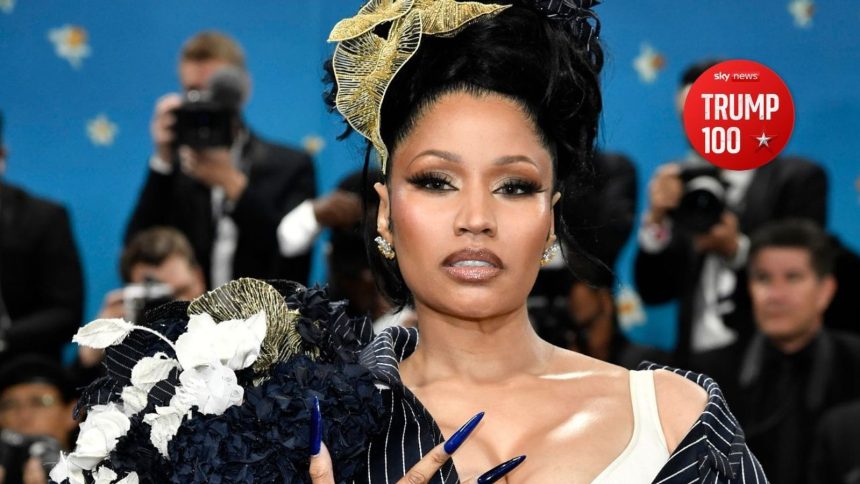
US-Trinidadian rapper Nicki Minaj has stirred fresh controversy after publicly backing former US President Donald Trump’s claims that Christians in Nigeria are facing widespread persecution — a narrative Nigerian officials and security analysts continue to reject as misleading.
Speaking at a US Embassy–hosted event at the United Nations, Minaj praised Trump for what she called his “leadership” and “urgent call to defend Christians in Nigeria,” arguing that faith-based violence in the West African nation has been ignored for far too long.
Standing alongside US Ambassador to the UN Mike Waltz, Minaj said Christians in Nigeria were “being targeted, driven from their homes and killed,” and that churches had been burned while families “live in constant fear simply because of how they pray.”
The claims echo Trump’s recent remarks accusing Nigeria of “tolerating” violence against Christians and threatening possible military action — a statement that has ignited diplomatic tension.
Nigeria Rejects Narrative, Calls Claims ‘Unfounded’
Officials in Abuja were quick to dismiss the allegations, noting that while parts of Nigeria face serious insecurity, the narrative of “Christian persecution” oversimplifies a far more complex reality.
The government argues — and several international researchers concur — that Muslims are in fact the primary victims of Boko Haram insurgency and extremist violence in the northeast.
Nigeria’s Foreign Minister Yusuf Tuggar recently criticized Washington for “misunderstanding the conflict,” stressing that the government has invested significantly in counter-terrorism operations. Analysts warn that portraying Nigeria’s security crisis as a religious war risks inflaming tensions and undermining peacebuilding efforts.
Minaj’s Controversial Relationship With Religious Communities
Minaj’s remarks come amid a history of uncomfortable encounters with the Christian conservative community in the US. Her 2012 Grammy appearance — where she arrived with an actor dressed as a Pope and staged a mock exorcism — sparked heavy backlash from Catholic groups at the time.
Despite that history, the superstar has increasingly amplified Christian-focused messages on social media, where she commands millions of followers.
At the UN event, Minaj insisted her comments were “not about division,” but rather about “uniting humanity” around protecting people persecuted for their beliefs.
A Debate That Refuses to Settle
Her intervention arrives at a moment when narratives of “Christian genocide” in Nigeria continue to spark global debate. Advocacy groups in the US and Europe have repeatedly framed Nigeria’s violence as faith-targeted, despite research showing a blend of political, economic, ethnic, and territorial drivers rather than purely religious motives.
Trump’s newly revived commentary appears to have reopened old disputes — and Minaj’s star power has now brought the discussion into mainstream entertainment circles.
Whether her statement shifts global opinion remains to be seen. But for Nigeria, the concern is clear: a simplified global narrative risks overshadowing a complex crisis that affects citizens of all faiths.